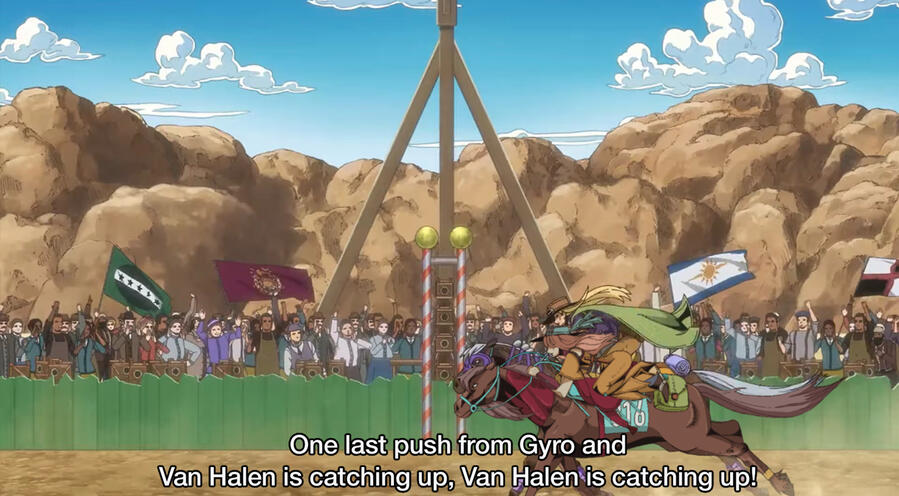
Steel Ball Run fan-made character

Angeleon van Halen
アンジェレオン・ヴァン・ヘイレン
CV.
none
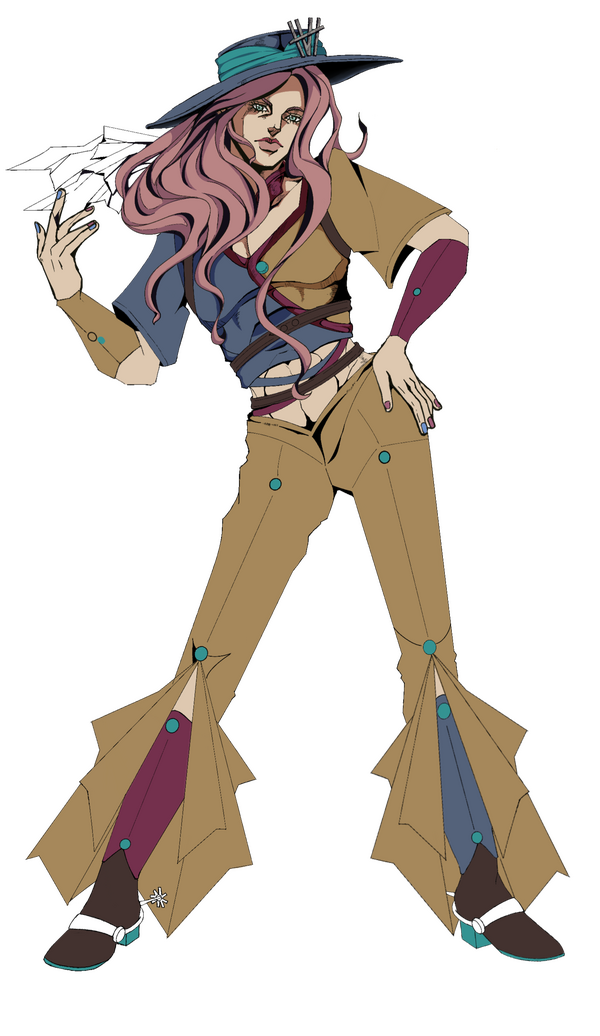
A noble who comes all the way from the Kindom of Holland who have gotten invited in the "Steel Ball Run," a transcontinental race across North America, by Steven Steel himself as an Honoured Guest.He held an heirloom from his mother that posess such power and by using it he can pursue what he wanted to pursue.Riding Horse name : Panama
BIO
Name: Angeleon van Halen.
Fullname: Arya Leon van Halen.
Nicknames: Van Halen.Gender: Male.
Pronouns: He/HimNationality: Netherlands
Race: Dutch - AsianBirthday: 15 May 1870
Age during SBR: 20
| ⊹₊˚‧︵‿₊୨ᰔ୧₊‿︵‧˚₊⊹ | |
|---|---|
| PERSONALITY | Angeleon van Halen is a kind-hearted, compassionate, and deeply idealistic young noble whose grace and refinement often hide the loneliness he carries. Raised as the miracle child of one of Europe's wealthiest banking dynasties, he has spent his entire life living up to the expectations of others—as the heir to the Van Halen empire, a descendant of Dutch and Javanese royalty, and the celebrated "Equestrian Angel of the Netherlands." Despite his fame, intelligence, and privilege, he longs for a life where he can simply be himself rather than a symbol of his family or his nation. His greatest strength is his unwavering sense of justice; he instinctively protects those he believes are vulnerable, even if they are complete strangers. However, that same compassion is also his greatest flaw. Angeleon is quick to judge situations based on what he sees in the moment, often acting before learning the full truth. His idealistic worldview leads him to divide people into right and wrong too easily, making him emotionally driven rather than purely rational. Beneath his polished manners and confident smile is a young man who quietly craves genuine companionship—people who see Leon instead of the famous rider or the future banking patriarch. Horseback riding becomes his sanctuary because it is the one place where titles, wealth, and expectations disappear. While riding across an open field, he is not a nobleman, a celebrity, or an heir; he is simply a rider and his horse, free from the burdens of legacy. More than wealth or glory, Angeleon longs for freedom, authentic relationships, and the chance to choose his own path in life, even if doing so means disappointing the world that has always expected perfection from him. |
| APPEARANCE | Angie is... |
RELATIONSHIPS
| Jan Louis van Halen. | His Beloved Father or what he claims to be, He loved his father but sometimes he couldn't stand his father's high expectations and ambition towards him. |
| Johnny Joestar. | He met Johnny during the Steel Ball Run Race in America, He met him during his walk, He saw Johnny being treated awfully by Gyro Zeppeli. |
| Gyro Zeppeli. | At first he's indifferent about him, he saw Gyro as an uneducated brute who's only brave to a disabled person, but time goes by he put up a respect to him after up hearing his story and his burden as an executioner and join the SBR for an amnesty. |
| Steven Steel. | One of his father's client, the man who invited him to be an honoured guest to fill up the Steel Ball Run Race event, he's neutral about him and he respects Steven Steel as both promoter and client. |
TRIVIA
His Hometown Amsterdam is a city in Netherlands as well as a reference to Van Halen's song (under the same name) Van Halen - Amsterdam.
His Birthday is a direct reference to Van Halen's Song. 5150 - Van Halen ; 5/15/0 (May 15 1870).
His current horse namesake is taken from Van Halen's song called Panama
His horse number/ saddle number is taken from Van Halen's instrumental break 316 ; 316 - Van Halen.
His Stand name derived from Van Halen's Album : Balance.
Angeleon van Halen's background is inspired by both members of the Van Halen's vocalist & drummer, Eddie & Alex van Halen, both of them are Dutch-Indonesian descent, their mother was also Dutch-Indonesian mix as well.
If Angeleon's name includes his mother's royal title his name would be "Raden Mas Arya Leon van Halen".
Angeleon grandmother's marriage for politics is inspired by the France Dauphine Marie Antoinette who was sent off to marry Louis XIV for peace between Austria & France.
Angeleon's aesthetic is somewhat similar to the Versaille's aesthetic, Rococo.
His color palette resembles the color of the national flower of the Netherlands, Daisies (& Tulips), although Tulips aren't exactly the national flower of Netherlands but Tulips has been recognised as Netherlands identity somehow.
HISTORY
Historical Background
During the 19th century, much of modern-day Indonesia was known as the Dutch East Indies, a colony administered by the Kingdom of the Netherlands. Despite Dutch influence across the archipelago, the Sultanate of Yogyakarta retained a degree of autonomy under agreements with the Dutch government. The Sultan continued to rule Yogyakarta as its sovereign, although the kingdom operated under Dutch protection and political influence.The Van Halen family
The Van Halen Family is an international Dutch banking dynasty founded in Amsterdam, the Kingdom of the Netherlands, in the 1700s by the third son of the Dutch monarch. Over the centuries, the family built a multinational financial network that helped reshape banking across Europe and later expanded into North America. Today, the Van Halen family oversees several financial institutions, including Van Halen & Co. and The Jan van Halen Group, stylized as JVH Group.Family History
In the Kingdom of Yogyakarta, the reigning Sultan had three children—two sons and one daughter.Unable to fully subjugate Yogyakarta through military force, the Dutch instead sought to strengthen their political influence through marriage. A daughter from an influential Dutch government family was arranged to marry the Sultan's second son, Prince Aryadiningrat, in the hope of securing lasting peace and closer ties between the two governments.Several years later, the Sultan passed away from old age. His eldest son inherited the throne but died only a few years later after a prolonged illness. With no surviving heirs from the first Sultan, the crown passed to Prince Aryadiningrat and his Dutch wife.The royal couple later welcomed twins: Raden Mas Aryadiningrat Johannes II, the future heir to the throne, and Raden Rara Ayu Wilhelmina, the beloved princess of Yogyakarta.Around the same time, a wealthy Dutch nobleman arrived in Yogyakarta to negotiate business with members of the Javanese aristocracy. Accompanying him was his son, Jan Louis van Halen, a talented accountant who had begun building a reputation within his family's banking enterprise.During his stay, Jan met Princess Wilhelmina. What began as a chance encounter quickly blossomed into romance. After only three months of courtship, he asked for her hand in marriage.Overjoyed, Wilhelmina sought her father's blessing. The Sultan, however, refused. Although Jan was wealthy and came from a respected Dutch noble family, he viewed the relationship as politically dangerous and feared losing his daughter to Europe.Heartbroken but determined, Wilhelmina chose love over duty. She left Yogyakarta and sailed to the Netherlands with Jan.Life in Europe proved far more complicated than either had expected. Despite her royal birth, many members of Dutch high society looked down upon those born in the East Indies, often considering them socially inferior regardless of status.To shield her from prejudice and protect both their reputations, Jan advised Wilhelmina to present herself simply as Wilhelmina van Halen, omitting her Javanese royal titles. Publicly, she was introduced as a woman of Dutch and German ancestry—a claim few questioned, as her mixed heritage gave her features that many Europeans perceived as more European than Asian.Only Jan, his immediate family, and a handful of trusted confidants knew that she was, in truth, a princess of the Sultanate of Yogyakarta.
STORY
Chapter 1 : The Birth of Leon
Despite their happy marriage, Jan Louis and Wilhelmina endured years of heartbreak. Wilhelmina suffered three miscarriages, and with each loss, the couple grew less hopeful that they would ever have a child of their own.Then, on 15 May 1870, what they had long prayed for finally came to pass.Wilhelmina safely gave birth to a healthy son. Together, they named him Arya Leon van Halen, honoring both his Javanese heritage through the name Arya and his Dutch lineage through the Van Halen family name.As the only child of Jan Louis van Halen and Wilhelmina van Halen, Leon was raised in extraordinary privilege. Born into one of Europe's wealthiest banking dynasties and descended from both the Dutch nobility and the royal house of Yogyakarta, great expectations were placed upon him from an early age.Chapter 2 : Childhood
His upbringing was strict. Every aspect of his education was carefully planned, as his father intended for him to one day inherit and lead the Van Halen banking empire. Through his mother's bloodline, Leon also remained a distant descendant of the Dutch royal family, making his conduct and education matters of family pride.Leon began riding horses at the age of three. Recognizing his son's remarkable balance and confidence in the saddle, Jan personally oversaw much of his equestrian training. As Leon grew older, his lessons expanded to include dressage, hunting, and polo, sports commonly associated with Europe's upper class.Education occupied most of his childhood. Leon was tutored by some of the finest private instructors available, studying history, mathematics, economics, diplomacy, law, literature, and classical philosophy. His father believed that a banker should not merely understand money, but also the governments and people behind it.Languages were another essential part of his education. By the time he reached adolescence, Leon spoke Dutch, German, English, Latin, Spanish, and Italian fluently. He also possessed a conversational knowledge of French, while his mother quietly taught him Javanese, ensuring he never forgot the heritage she had left behind. Jan often reminded him that in international finance, a man's ability to speak another's language could open more doors than wealth alone.When Leon was five years old, Jan's expanding business interests required the family to relocate to the United States. The Van Halens spent several years moving between growing commercial centers, including Los Angeles, California, and Denville, Kentucky, where Jan managed investments, railroads, and banking partnerships.Although Leon was still a child, the journey exposed him to a rapidly industrializing America. He witnessed bustling ports, expanding railroads, and cities growing at a pace unlike anything in Europe. Jan often took him to meetings, encouraging him to observe rather than speak, believing that listening was the first lesson of leadership.After nearly five years abroad, the family's affairs in America were settled. At the age of nine, Leon returned with his parents to Amsterdam, where his formal education resumed and preparations quietly began for the day he would inherit the Van Halen legacy.Chapter 3 : The Angel of Netherlands
By the time Leon turned fifteen, he had become one of the finest young horsemen in the Netherlands. Years of relentless training had given him exceptional control in the saddle, but outside his family's circle, few people knew of his talent.That same year, Dutch equestrian sport was enduring a difficult period. The Kingdom of the Netherlands had suffered a string of disappointing finishes in several prestigious European horse races, leading newspapers and critics to claim that Dutch riders could no longer compete with the continent's best.Leon found the criticism unbearable.Ignoring the objections of his family and the skepticism of the racing community, he volunteered to represent the Netherlands at one of Europe's most celebrated international horse racing events.Many laughed at the announcement.To the public, he was merely a handsome aristocratic teenager—a wealthy banker's son who had spent his life surrounded by luxury. Few believed that a "pretty boy" from Amsterdam could possibly outperform seasoned riders from Britain, France, Austria, and Prussia.Leon answered every doubt on the racetrack.Displaying remarkable composure, flawless technique, and an almost supernatural bond with his horse, he surged through the field and crossed the finish line ahead of competitors who had been favored to win. His victory stunned spectators and sporting officials alike.The result secured one of the Netherlands' highest international equestrian achievements in years, restoring pride to a nation that had feared it was falling behind the rest of Europe.Almost overnight, Leon became a national celebrity.Newspapers celebrated his triumph, artists painted his portrait, and crowds gathered wherever he appeared. Before long, the public gave him a nickname that would follow him for the rest of his life:The Equestrian Angel of the Netherlands.To many, his victory felt almost miraculous—as though he had answered the hopes of an entire nation.In the years that followed, Leon gradually began using a different name in public.Although he treasured the name Arya, inherited from his mother's Javanese heritage, he believed it sounded too foreign for the image expected of a Dutch national figure in the late eighteenth century. Wishing to embrace a name that reflected both his public identity and the title the people had given him, he adopted the name Angeleon van Halen.The name combined Angel with Leon, preserving part of his birth name while symbolizing the reputation he had earned. Many later remarked that Angeleon resembled the Greek word evangelion, meaning "good news" or "glad tidings."For countless Dutch citizens, the comparison felt fitting.To them, Angeleon van Halen had become the answer to their prayers—the young horseman who restored the nation's honor and proved that the Netherlands could once again stand among Europe's greatest equestrian powers.
STEEL BALL RUN
Stage 1 : Honoured Guest
When the Steel Ball Run was announced in America, its founder, Steven Steel wanted the event to become more than just a cross-country horse race. He envisioned it as an international spectacle that would attract athletes, aristocrats, businessmen, and celebrities from around the world.One name immediately came to mind : Angeleon van Halen.By then, Angeleon was already one of Europe's most celebrated equestrians. His victories had restored Dutch pride in international horse racing, and newspapers across the continent eagerly followed his every appearance. Having him attend the Steel Ball Run would guarantee enormous public attention.There was another reason for the invitation.The Van Halen banking empire was one of the principal financial backers of the Steel Ball Run, and Steven himself had long been a valued client of Jan Louis van Halen. Rather than sending a formal letter through intermediaries, Steven personally invited both Jan and his son to America as honored guests.Angeleon's role was never meant to be that of a competitor.He was scheduled to attend the opening ceremonies, greet spectators, and provide commentary and analysis during portions of the race. As a gesture of appreciation—and perhaps as a clever publicity stunt—the organizers even prepared a racing number exclusively for him.Number 316.The number had been deliberately reserved because it was the same number Angeleon had worn during his most famous victory in Europe. No other rider was permitted to use it.On the morning before the race, Angeleon arrived in America accompanied by several servants, including his family's longtime butler and a small household staff. Curious about the country beyond the grand hotels and official receptions, he eventually excused himself from their company and wandered into a nearby town alone.It was there that fate intervened.From across the street, he noticed two men arguing beside a wheelchair.One was a long-haired Italian rider whose confidence bordered on arrogance. The other was a young American confined to a wheelchair, who appeared visibly frustrated and humiliated.From Angeleon's perspective, the scene looked cruel, unable to ignore it, he stepped between them."You uneducated brute," he said coldly, fixing the Italian with an icy stare. "Why would you treat this man with such disgrace?"The Italian—Gyro Zeppeli—clicked his tongue in annoyance.
Rather than answering, Angeleon simply met his gaze.Believing the young nobleman was interfering in something he didn't understand, Gyro flicked one of his Steel Balls into his hand and prepared to drive him away.The instant he released it, however, something unexpected happened.Hanging from Angeleon's belt was an intricately carved keris, an heirloom entrusted to him by his mother before he departed for America. The blade seemed to resonate for a brief moment, and the Steel Ball's mysterious energy simply... vanished before it could reach him.The attack lost its force completely.
Gyro frowned, realizing that whatever had happened was beyond his understanding—and seeing little point in escalating the confrontation—he scoffed before turning his back and walking away.Once Gyro had left, Angeleon knelt beside the young American.Without a word, he helped him back into his wheelchair, dusted off his coat, and offered a polite smile.The stranger introduced himself as Johnny Joestar.The encounter lingered in Angeleon's mind for the rest of the day.He had come to America merely as a guest, but the image of a disabled man being spoken to with such contempt refused to leave him. Whether he had misunderstood the situation or not no longer mattered to him.He had already made up his mind.
"I will ride," he declared.Not for the prize money.
Not for fame.But because he refused to stand by after witnessing what he believed was an injustice.Only hours before registration closed, Angeleon personally requested permission to enter the Steel Ball Run.The announcement sent waves through the entire venue.
Spectators erupted into cheers.
Reporters scrambled to rewrite their headlines.Even Steven Steel was caught completely off guard.
"You... you're entering?"Jan Louis stared at his son in stunned silence before letting out a weary sigh. He had crossed the Atlantic expecting to watch the race—not to see his only heir compete in one of the most dangerous endurance events in the world.
Still, he knew better than to argue once Angeleon had made up his mind.The reserved number 316 was finally placed on a competitor's saddle.Its intended owner.As the race began, Angeleon paid little attention to the other contestants. His eyes remained fixed on one rider alone.Gyro Zeppeli.Whenever Gyro tried to gain ground, Angeleon matched his pace. Whenever Gyro accelerated, Angeleon answered with equal determination. It became almost comical how relentlessly the Dutch rider refused to let him pull ahead.By the time they reached the finish of the opening stage, the rivalry had already become the talk of the race.Neither man was willing to yield.They crossed the finish line side by side, denying the other a clear victory.From that moment onward, everyone understood one thing:
The celebrated Equestrian Angel of the Netherlands had entered the Steel Ball Run—not for glory, not for fortune, but because one brief encounter with two strangers had ignited a rivalry that neither rider intended to abandon.